


How to Evaluate Medical Device Changes
Your medical device has been performing well, but you want to make it better. The FDA and the EU both require that all changes to medical devices be reviewed, verified, validated (as appropriate), and approved prior to implementation - but what does this actually mean? Let’s break it down:
Reviewed
Proposed changes to medical devices must be reviewed to determine their impact on existing product performance, safety, and documentation. This includes evaluations of requirements, production processes, testing, and risk management. Specifically, it should include determinations of whether:
·Any new user needs, design inputs, design outputs, equipment, and/or manufacturing process requirements are needed to account for the new features or functionality being added
Any modifications to existing user needs, design inputs, design outputs, equipment, and/or manufacturing process requirements are needed to account for the changing features or functionality
Existing design verification and/or design validation testing will still be applicable to the modified medical device or whether all or part of design verification and/or design validation testing must be repeated
The production equipment and processes (including inspections) for the modified medical device will still be operating within their validated ranges, whether equipment qualifications must be repeated, and whether process performance qualifications must be repeated.
New production processes must be developed and whether new production equipment is required along with what qualification activities are needed for these new equipment and processes
There are any new or changes to existing risks or benefits
Any changes to labeling are needed to discuss the new or changing features or functionality or disclose the risks associated with them
Any regulatory notifications or submissions are required for the change in any region
Once you’ve determined the impact on existing product performance, safety, and technical documentation, you can weigh this against the estimated business benefit of making the change to determine whether pursuing this design change is worth it. If you still want to pursue this change, you’ll need to verify, validate, and approve it.
Verified
If the design features being changed could impact the results of design verification testing, design verification testing must be repeated on the modified medical device. Only tests whose outcomes could be impacted by the proposed change need to be repeated.
Verification must also occur for the design features being changed during the production process. This typically means repeating any inspections associated with changes to the production process as well as that impact the production processes accompanying the design change.
Validated
If the design features being changed could impact the results of design validation testing, design validation testing must be repeated on the modified medical device. Only tests whose outcomes could be impacted by the proposed change need to be repeated.
Additionally, the production processes used to manufacture and inspect the modified device must be re-validated if they change (e.g., modification of a CNC program for a size change) or if the device design could impact the outcome of the production process (e.g., sterilization).
Approved
The results of the review (i.e., determination of what work must be done to support the design change) as well as the work itself (i.e., updates to requirements, completion and documentation of verification and validation testing, updates to risk management documents) must be approved prior to implementing the design change. It’s not enough to say that you understand the work that is required to execute a design change, you actually have to complete that body of work prior to making the modified medical device available to customers.
Case Study
Let’s walk through a case study for a hypothetical medical device change. This case study will go over the activities required to complete each step of the process to implement the new sterile fracture plate.
ABC Orthopedics sells a non-sterile version of an orthopedic fracture plate in the US and EU. Recently, some customers have been requesting that the fracture plate also be sold sterile, so ABC Orthopedics has decided to pursue selling a separate sterile fracture plate that is sterilized via gamma irradiation. ABC Orthopedics does not have sterilization capabilities in house and must engage a supplier to perform the gamma sterilization.
Review
Since the need for a sterile packed fracture plate was previously unknown, a new user need for a sterile fracture plate must be created. This user need must be translated into new design inputs that establish requirements for sterility assurance level, sterile packaging, and sterile shelf life.
New sterile packaging must be developed.
New part numbers must be assigned for the sterile fracture plate.
New production processes for sterile package sealing and gamma sterilization must be developed.
Risk management documentation must be updated to include the risks and benefits associated with the sterile fracture plate as well as the sterile packaging and gamma sterilization processes.
New labeling on the carton and sterile packed device must be developed with the new sterile fracture plate part number as well as an indication that the product is sterile and the method of sterilization
Regulatory applications must be submitted to the US and EU.
Verified
Design verification testing for sterility assurance level, sterile packaging, and sterile shelf life must be completed to confirm that the fracture plate is sterile and remains sterile for at least its stated shelf life.
Distribution design verification testing must be repeated on the new sterile configuration.
An inspection to confirm completion of gamma sterilization must be added to the production process for the sterile parts.
Validated
New sterile package sealing equipment must be qualified.
A new sterilization supplier must be qualified.
Production processes for sterile package sealing and gamma sterilization must be developed.
A periodic revalidation schedule must be established for the sterilization and sterile package sealing processes to ensure these high risk processes remain within their validated state.
Irradiation dose and bioburden monitoring programs must be established ensure that the sterilization process continues to be effective.
Approved
The following must be approved:
Updates to user needs and design input documentation
Sterile package specifications
Updates to risk management documentation
Design verification reports
Supplier qualification reports
Equipment qualification reports
Process validation reports
Periodic revalidation schedules
Dose audit and bioburden monitoring programs
Manufacturing and inspection work instructions
Labeling
In addition, regulatory clearance or approval of the change must be received prior to making the updated medical device available to customers in that region.
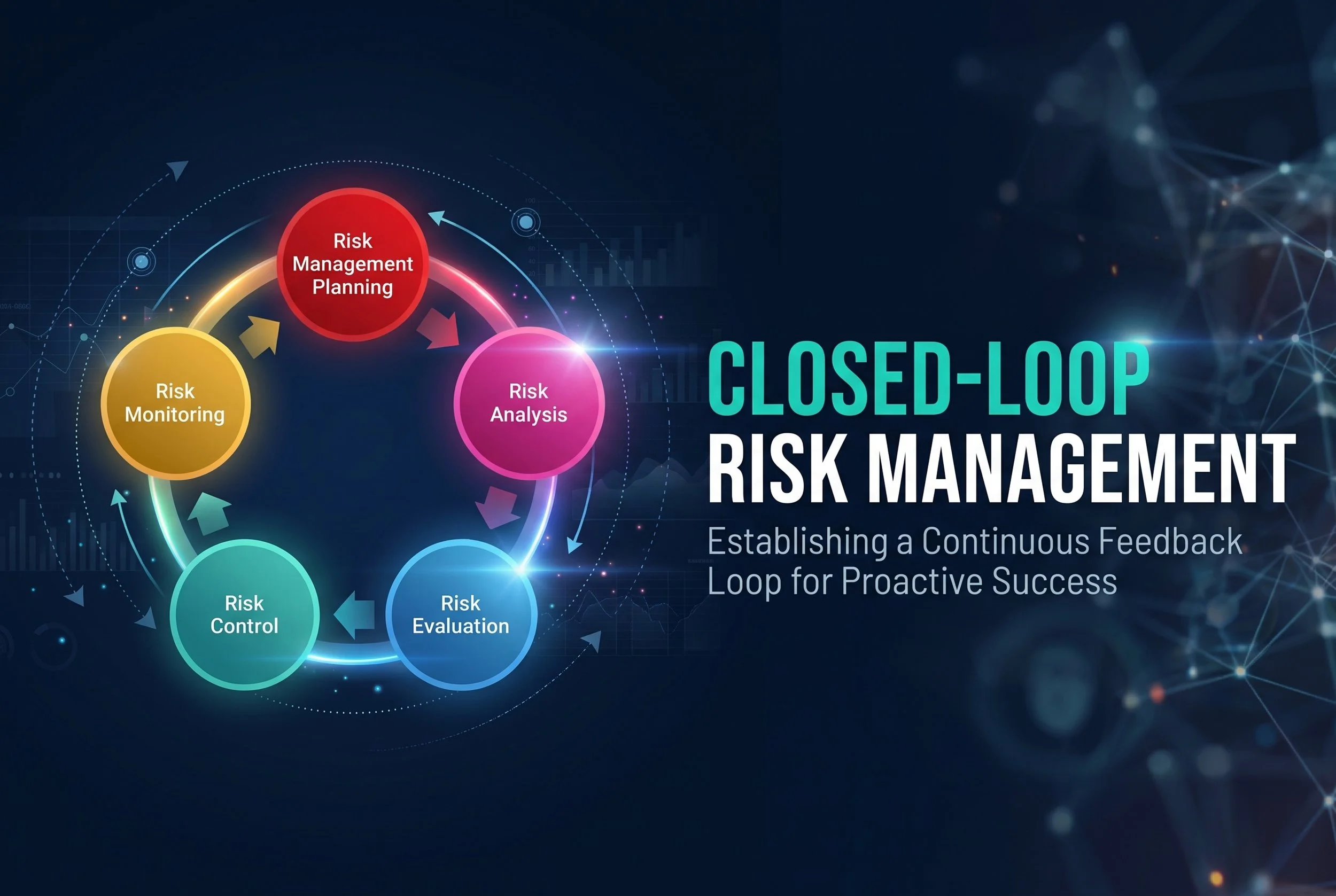
Closed Loop Risk Management
Most risk management processes are linear, but a compliant risk management process is a closed loop process where new information is compared against and added to the risk management file.
One of the biggest changes in the transition from the FDA’s regulations from the Quality System Regulation (QSR) to the Quality Management System Regulation (QMSR) is a larger focus on risk management. In ISO 13485: 2016, risk management is integrated into many processes outside of product development including supplier management, training, software and production process validation and revalidation, incoming inspection, and purchasing. A recent warning letter issued by the FDA highlights one of the problems that some companies are having implementing an FDA QMSR compliant risk management process.
Olympus Medical Systems Corporation (MARCS-CMS 729208) October 7, 2026
During an inspection of the Shirakawa facility, it was noted that they “failed to identify and control known catastrophic hazards”. Catastrophic hazards including air embolism, arrhythmia, and patient death were identified during a health hazard evaluation, but these hazards were not controlled or included in the risk management file.
During an inspection of the Aomori facility, it was noted that they “failed to identify and assess known hazards in the risk management documentation and failed to establish risk control measures” for a manufacturing process even when an analysis of FDA Medical Device Reports (MDRs) identified risks associated with unintended cutting of blood vessels leading to patient bleeding.
These 2 findings are the result of not implementing and/or executing a closed loop risk management process. Many risk management processes are linear – they start with risk management planning, move through risk analysis, risk evaluation, and risk control and end with risk monitoring.

Image Credit: Cooperative Quality Solutions
A closed loop risk management process connects risk monitoring back to risk management planning and analysis. This forces comparison of risk monitoring data against the risk management file to identify any new or changing risks.
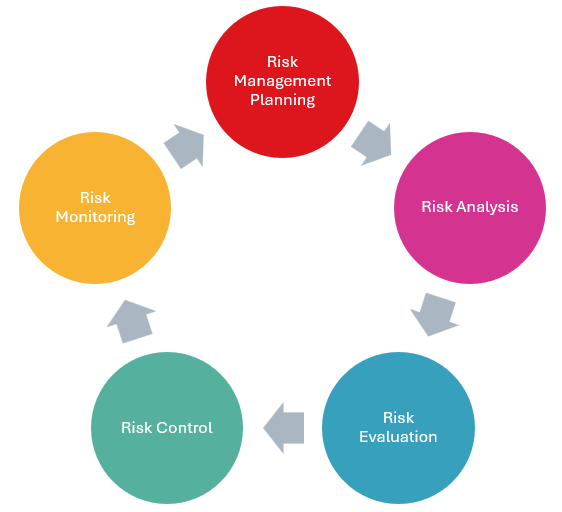
Image Credit: Cooperative Quality Solutions
In both instances cited in the FDA warning letter, a closed loop system that required a comparison of hazards and harms identified within health hazard evaluations and MDR analyses to the hazards and harms identified in the risk management file would have prevented these findings.
Closed loop risk management processes ensure that any new or different harms discovered as part of monitoring production and post-production data are contained within the risk management file and therefore ensure that the risk management file is complete, accurate, and up to date.
How Do I Implement a Closed Loop Risk Management Process?
Contact Cooperative Quality Solutions to discuss how to integrate closed loop risk management processes into your quality management system.
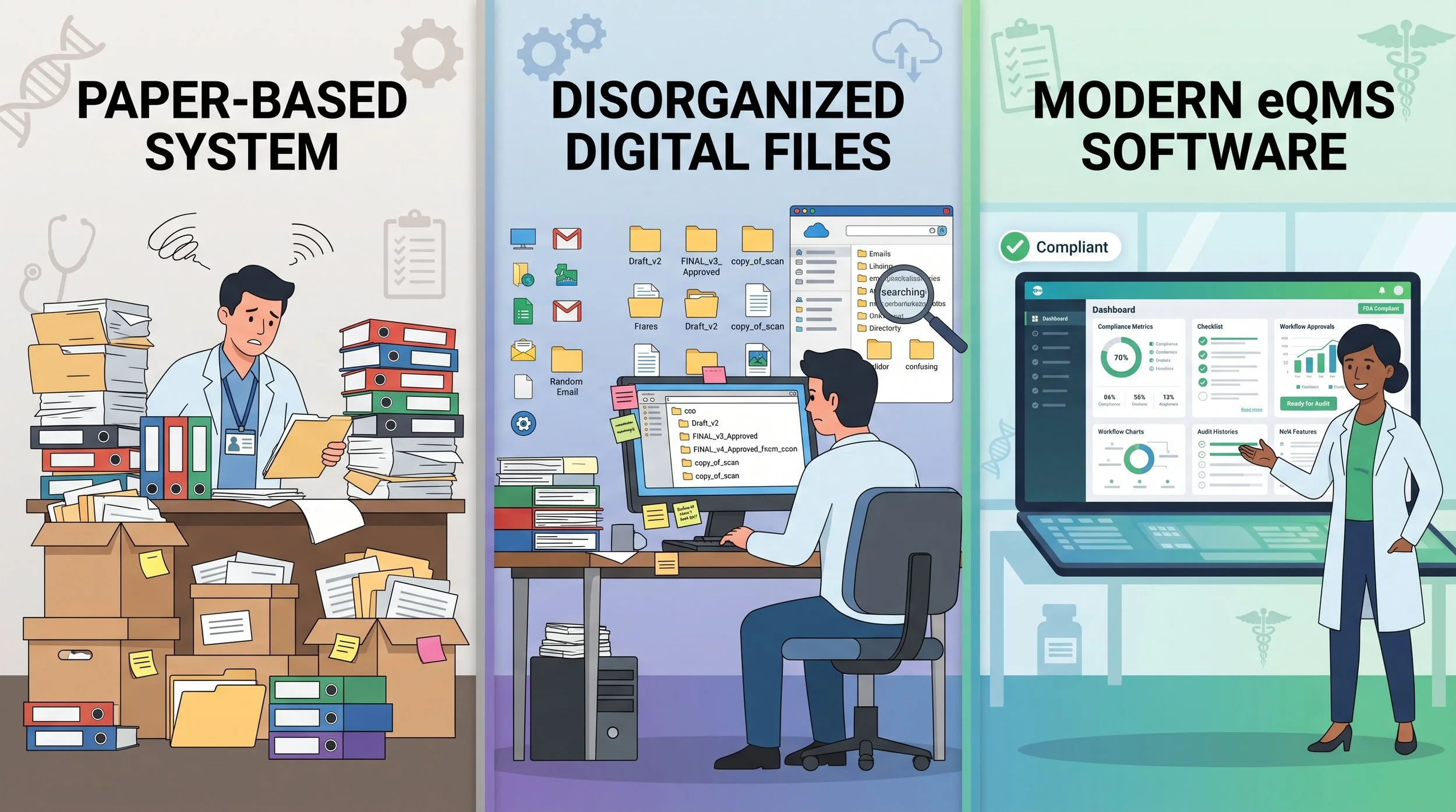
Do I Need an Electronic Quality Management System?
Electronic quality management systems (eQMSs) are powerful tools that connect different types of quality data, enforce workflows, and allow easy access to information within your quality management system, but they can also be expensive. Whether or not you “need” an eQMS depends on many factors. Here are a few questions to consider
1. Are the people in the company co-located?
If everyone works in a single on site location, you can use a paper based QMS. But, if folks are spread out across the country or even across the world, you’ll need a 21 CFR Part 11 compliant method of storing and approving documentation.
2. Do the people at the company have extensive experience working in the medical device industry and following cGMPs?
If the people at the company are used to operating within a QMS and know what the current cGMP requirements are, an electronic paper system (i.e., using electronic signatures and storing documents in a shared electronic location) can work well. Discipline is required to ensure that electronic records are stored in the correct location, editing permissions are limited, and that approved records are not modified or overwritten. Significant quality assurance oversight is required to enforce manual processes.
3. Are the people at the company good at following written procedures?
If people at the company aren’t good at remembering to follow a written procedure to execute a process, strong QMS controls are required and an electronic paper system is not a good solution. A fully featured eQMS software will force workflows and required reviews and approvals, which can be helpful for those not used to operating within a regulated industry. A fully featured eQMS software can be burdensome to implement, but requires less quality assurance oversight during use.
4. Are you currently executing all QMS processes?
If you’re still early in the design and development process and aren’t generating nonconformances or complaints, a pared down eQMS software may be a good solution. There are several 21 CFR part 11 compliant software solutions for document control and some fully featured eQMS software offer their software modularly (e.g., you can buy the system 1 module at a time). This can be a great option for companies that eventually want a fully featured eQMS software, but don’t need all the eQMS software features just yet.
Want to discuss whether an eQMS is right for you?
Contact Cooperative Quality Solutions to discuss eQMS software solutions.

Can I use AI for Quality and Regulatory?
When to use AI for quality and regulatory
The use of artificial intelligence (AI) is a hot topic in the medical device industry today. With the financial and time pressures that many medical device companies are under, it can be tempting to use artificial intelligence to replace the expertise provided by consultants. While AI can be a useful tool to obtain and summarize information as well as generate documentation, overreliance on it can be dangerous. Knowing when and how to use AI for quality and regulatory purposes can help you utilize it effectively.
The Problem with AI
1. AI only knows what you tell it
A quality management system is a complex set of quality manuals, standard operating procedures, work instructions, forms, and records. But, questions asked to AI typically only submit a small portion of information. This can result in AI generating content that already exists in other places in your QMS, content that conflicts with information in other places in your QMS, or content that is not correct.
2. AI doesn’t always know the latest in medical device standards and regulations
Regulation and standards requirements for medical devices are constantly changing. One of the benefits of AI is that it mines information from multiple sources and mitigates the risk of relying on a single unreliable source. Unfortunately, this means that AI mines both outdated and current requirements and can generate responses that don’t comply with current expectations. This is especially true for recently revised requirements since the AI model training material on the old requirements outweighs the AI model training material on the new requirements.
3. Public AI clients can mine confidential information
If you use public large language models, they can mine any information you submit to it and train their models using it. This can result in your company’s confidential information being shared in AI results provided to other companies.
When Should I Use AI?
1. To identify primary sources
Not sure which standards or regulations govern biocompatibility testing? Ask AI to identify those sources for you, then read those standards and regulations yourself to understand the requirements.
2. To generate a first draft
If you’re using a private instance of an AI model, submitting relevant information to an AI model to generate a first draft of a document can be helpful. However, a human will still need to review the AI-generated draft to ensure it meets applicable requirements, communicates information succinctly in a way that is understandable to regulatory agencies, and works with existing documentation in your quality management system. A recent warning letter issued by the FDA to Purolea Cosmetics Lab states that “if you use AI as an aid in document creation, you must review the AI generated documents to ensure they were accurate and actually comply” with applicable requirements. In this warning letter, the FDA makes it clear that relying only upon AI generated content is not permitted.
When Should I Use an Expert?
While AI can help answer some questions about quality and regulatory requirements for medical devices, any answer generated by AI should be reviewed by an expert for accuracy. Bringing AI generated content to an expert for review can be a method to reduce the work required by an expert. But, be aware that if the AI generated content is poor quality, it can take longer to revise the AI generated content than it would have taken for the expert to create the content from scratch.
Do You Have Questions About When to Use AI?
Contact Cooperative Quality Solutions to discuss how to incorporate AI into your workflows while ensuring that any AI generated content is correct and compliant.